Hey there! I’m a supplier of D – SUB cables, and today I wanna chat about how to measure the resistance of a D – SUB cable. It’s a crucial aspect, especially if you’re in the business of using or supplying these cables, like me. D-SUB Cable
First off, why do we even need to measure the resistance of a D – SUB cable? Well, resistance can tell us a lot about the cable’s performance. A cable with high resistance might cause signal loss, overheating, or other issues that can mess up the equipment it’s connected to. So, getting an accurate measurement is super important.
Let’s start with the tools you’ll need. You’re gonna need a multimeter. It’s a handy device that can measure various electrical properties, including resistance. Make sure your multimeter is in good working condition and set to the resistance measurement mode. Most multimeters have a symbol for resistance, usually an omega (Ω).
Before you start measuring, it’s a good idea to prepare the cable. Check the cable for any visible damage, like cuts or frayed wires. If you find any, it’s likely that the resistance will be affected, and you might need to replace the cable. Also, make sure the cable is disconnected from any power source. You don’t want to get shocked while measuring the resistance!
Now, let’s get to the actual measurement process. There are a couple of ways to do this, depending on whether you’re measuring the resistance of a single conductor or the entire cable.
Measuring the Resistance of a Single Conductor
If you want to measure the resistance of a single conductor in the D – SUB cable, here’s what you do. First, expose the ends of the conductor you want to measure. You can carefully strip a small section of the insulation at both ends of the cable. Make sure you don’t cut the conductor while stripping the insulation.
Next, set your multimeter to an appropriate resistance range. If you’re not sure what range to use, start with a higher range and then adjust it lower if necessary. Place the probes of the multimeter on the exposed ends of the conductor. The red probe usually goes on the positive end (if there’s a clear polarity), and the black probe goes on the negative end.
Once the probes are in place, read the resistance value on the multimeter display. The value you get is the resistance of that single conductor. Keep in mind that the resistance can vary depending on the length and thickness of the conductor. A longer conductor will generally have a higher resistance, and a thicker conductor will have a lower resistance.
Measuring the Resistance of the Entire Cable
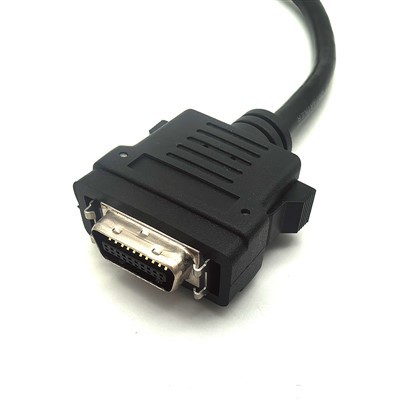
Measuring the resistance of the entire D – SUB cable is a bit more involved. You’ll need to measure the resistance between each pair of pins on the D – SUB connectors. There are different types of D – SUB connectors, like DB9, DB15, and DB25, each with a different number of pins.
Let’s take a DB9 connector as an example. You’ll need to measure the resistance between pin 1 and pin 2, pin 1 and pin 3, and so on for all possible pairs of pins. This can be a time – consuming process, but it gives you a comprehensive view of the cable’s resistance.
To do this, connect one probe of the multimeter to one pin on the D – SUB connector and the other probe to another pin. Record the resistance value for each pair of pins. You might notice that some pairs have a very low resistance, which is normal for conductors that are supposed to be connected. Other pairs might have a very high resistance or even an open circuit (infinite resistance), which could indicate a problem with the cable.
After you’ve measured all the pairs, you can analyze the results. If you find that the resistance values are within the expected range for the cable, then the cable is likely in good condition. However, if you find any abnormal resistance values, like a very high resistance where there should be a low one, or vice versa, then there might be a problem with the cable, such as a break in the conductor or a short circuit.
Factors Affecting Resistance
There are several factors that can affect the resistance of a D – SUB cable. One of the main factors is the material of the conductors. Different materials have different resistivities. For example, copper is a commonly used material for D – SUB cable conductors because it has a relatively low resistivity, which means it can conduct electricity well.
The length of the cable also plays a big role. As I mentioned earlier, a longer cable will have a higher resistance. This is because the electrons have to travel a longer distance through the conductor, and they encounter more resistance along the way.
The temperature can also affect the resistance. Generally, the resistance of a conductor increases as the temperature rises. So, if you’re measuring the resistance of a cable that has been in a hot environment, you might get a higher resistance value than if the cable was at room temperature.
What to Do with the Results
Once you’ve measured the resistance of the D – SUB cable, what do you do with the results? Well, if the resistance values are within the acceptable range, then the cable is good to go. You can use it in your equipment or supply it to your customers.
However, if you find that the resistance values are outside the acceptable range, you’ll need to take action. If it’s a minor issue, like a slightly higher resistance due to temperature, you might be able to let the cable cool down and then measure the resistance again.
If the problem is more serious, like a break in the conductor or a short circuit, you’ll need to repair or replace the cable. Repairing a D – SUB cable can be a tricky process, especially if the problem is deep inside the cable. In most cases, it’s easier and more cost – effective to replace the cable.
Why Choose Our D – SUB Cables
As a D – SUB cable supplier, I can tell you that our cables are made with high – quality materials and strict manufacturing standards. We test each cable thoroughly to ensure that the resistance is within the acceptable range. This means that you can trust our cables to provide reliable performance.
Our cables are designed to meet the needs of various industries, from telecommunications to industrial automation. Whether you need a DB9 cable for a computer connection or a DB25 cable for a more complex industrial application, we’ve got you covered.
If you’re in the market for D – SUB cables, I encourage you to get in touch with us. We can provide you with detailed information about our products, including the resistance specifications. We’re always happy to answer any questions you might have and help you find the right cable for your needs.
D-SUB Cable So, don’t hesitate to reach out if you’re interested in purchasing D – SUB cables. We’re here to make sure you get the best quality cables at a reasonable price.
References
- Electrical Engineering Handbook, Third Edition
- Practical Electronics for Inventors, Fourth Edition
Karobert Technology LLC Karobert Trading PTE. LTD.
We’re known as one of the most professional d-sub cable manufacturers and suppliers in China, also support customized service. Please feel free to buy high quality d-sub cable made in China here from our factory. For price consultation, contact us.
Address: 6250 S 196th St, Kent, WA, 98055, USA.
E-mail: karl@karobert-us.com
WebSite: https://www.karobert-us.com/
